

For many classic car fans, DAF might conjure up memories of compact Dutch saloons with quirky technology and surprisingly smooth driving. But if you weren’t around in the '60s and '70s, you might be wondering – what on Earth happened to DAF?
While DAF still exists today as a major name in commercial vehicles, the brand’s time as a car manufacturer was relatively short-lived. And yet, it left behind a unique legacy of innovation, economy, and eccentric charm - especially here in Britain.
DAF (short for Van Doorne's Automobiel Fabriek) was founded in the Netherlands in 1928, originally as a trailer manufacturer. It wasn’t until the late 1950s that DAF ventured into the world of car production.
What made DAF cars immediately stand out was their revolutionary transmission system: the Variomatic. This belt-driven, continuously variable transmission (CVT) gave their cars a totally different driving experience - no gear changes, no clutch pedal, just smooth, stepless acceleration.
For a post-war Europe still rebuilding, DAF’s cars were compact, efficient, and innovative. And by the early 1960s, they were ready to take on the UK market.
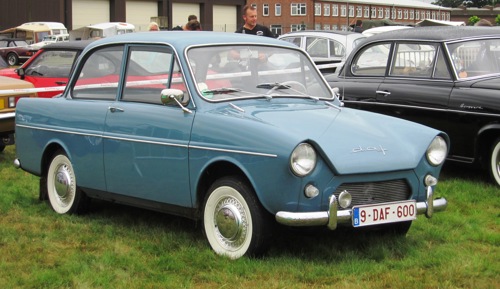
DAF officially launched its first passenger car, the DAF 600, in 1958, but it was the DAF 33, 44, and 66 models that really gained tration in the UK during the 1960s and early 1970s.
British drivers - particularly urban motorists, older drivers, and those looking for affordable automatic options - took notice of these oddball Dutch imports. While British manufacturers were still offering mostly manual gearboxes, DAF offered the only affordable automatic cars in their class.
Sales were modest but steady. The cars were never sporty or luxurious, but they were reliable, economical, and surprisingly smooth to drive, thanks to the Variomatic. The transmission even acted like a limited-slip differential, which made DAFs unexpectedly capable in icy or slippery conditions.
Despite their clever engineering, DAF cars remained a niche choice in the UK. Part of that was down to their unusual looks and the unusual driving experience. British drivers were used to feeling the mechanical engagement of gears, and the seamless hum of a Variomatic didn’t appeal to everyone.
Reviews were often mixed - some praised the cleverness, others criticised performance and refinement. DAFs were never fast, though later models like the DAF 66 showed real improvement in handling and build quality, especially after designer Michelotti got involved with styling.
Nevertheless, DAF built a loyal following among those who appreciated its engineering-first approach and practical sensibility.
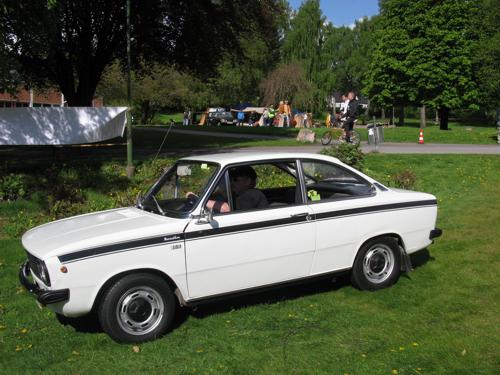
By the early 1970s, DAF's car division was under increasing pressure. Emissions standards were tightening, safety expectations were rising, and competition was fierce from both European and Japanese manufacturers.
In 1975, Swedish automaker Volvo stepped in, acquiring a majority stake in DAF’s car division. The goal? To gain a foothold in the small car market - and leverage DAF’s engineering expertise.
The DAF 66 was soon rebadged as the Volvo 66, complete with a more Volvo-like grille and enhanced safety features. But behind the badge, it was still very much a DAF.
Production of DAF-branded passenger cars officially ended in 1976. The Volvo 343, launched soon after, was built at the same Dutch plant and heavily based on DAF’s designs - still using a version of the Variomatic. In fact, early 343s even wore "DAF" logos on some components.
The transformation was complete: DAF as a car brand had quietly exited the UK stage.
While DAF cars vanished from showrooms by the late 1970s, they haven’t been forgotten. A small but passionate community of DAF enthusiasts still keeps the legacy alive in the UK. From lovingly restored DAF 33s to rally-prepped DAF 66s, these cars continue to surprise onlookers and judges at classic events.
Clubs like the DAF Owners Club UK offer technical support, parts sourcing, and a social hub for fans of the marque. And because many DAFs were mechanically simple and rugged, quite a few examples have survived, especially compared to other budget cars of the era.
DAF may not have made it big in the UK car market, but their story is far from a footnote. They were pioneers of CVT technology, decades before it became commonplace in hybrid and electric vehicles. They offered practical solutions in a rapidly changing world and carved out a unique identity at a time when innovation wasn’t always appreciated.


