


Motorsport trophies are, when you stop and think about it, slightly ridiculous.
A group of adults spend several hours driving at improbable speed, surviving mechanical chaos, questionable weather and each other, and are then rewarded with an enormous cup. Better still, everyone behaves as though this is the most natural thing in the world. It is wonderful.
And that is really the joy of motorsport trophies. They are not just prizes. They are theatre. They are branding. They are history lessons you can fill with champagne. Some are stately and dignified. Some are as subtle as a neon casino sign. Some arrive in vintage cars. Some travel in Louis Vuitton luggage. One famously carries the faces of its winners like a silver Mount Rushmore for racing drivers.
The earliest trophies leaned hard into grandeur. If you wanted your race to be taken seriously in the early years of motoring, you did not hand over a little glass plaque and call it a day. You commissioned something from a serious maker and made sure it looked like the sort of object that should live in a country house.
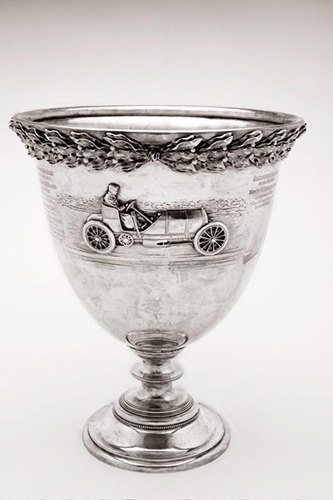
The Vanderbilt Cup, first raced in 1904, was a silver cup made by Tiffany, inscribed with the winners and even an image of William K. Vanderbilt in his Mercedes race car. Which is gloriously Gilded Age in spirit: if you are going motor racing, you may as well immortalise yourself on the prize.
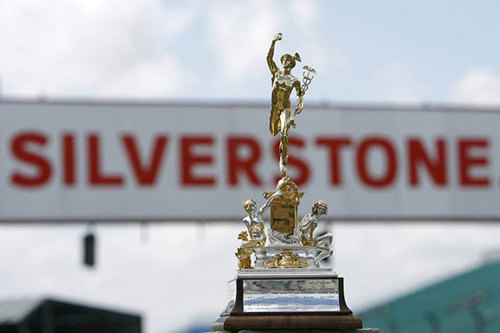
Britain, naturally, preferred something a little more classically grand. The Royal Automobile Club Tourist Trophy, first contested in 1905, pays tribute to Giambologna’s sculpture of Hermes and is embellished in 18-carat gold. So rather than a mere cup, the winner gets something topped by the winged messenger of the gods. As statements go, it is not exactly shy. It says that winning a motor race is not just sport. It is myth-making with petrol fumes.
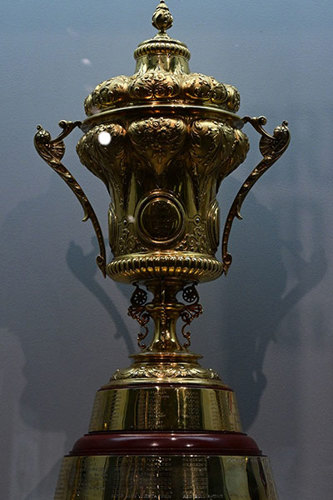
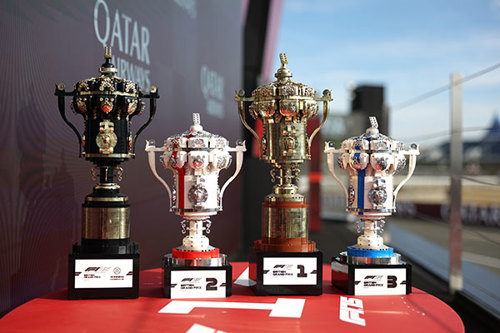
That instinct never really went away. The British Grand Prix Trophy, also in the care of the Royal Automobile Club, is described by Motorsport UK and the RAC as a Victorian two-handled cup covered in hallmarked sterling silver gilt. Which is exactly what you would hope the British Grand Prix trophy looks like: not sleek, not futuristic, not trying too hard, just an unapologetically grand bit of silverware that looks as though it has seen some things. It is less “cutting-edge design object” and more “something one might win after inventing steam”.
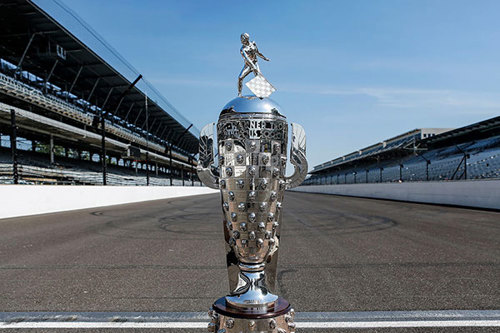
Then you have America, which tends to do these things in a slightly more maximalist fashion. The Borg-Warner Trophy for the Indianapolis 500 is one of the great pieces of sporting silverware anywhere. BorgWarner says it stands more than 5ft 4¾in tall, weighs about 110 pounds, is made of sterling silver, and was designed in 1930s Art Deco style with wing-like forms on the sides to symbolise speed. There is a flagman with a chequered flag on the top. And, best of all, the face of every Indy 500 winner since 1911 is attached to it in three-dimensional silver relief. It is magnificent, faintly bonkers and exactly right for Indianapolis.
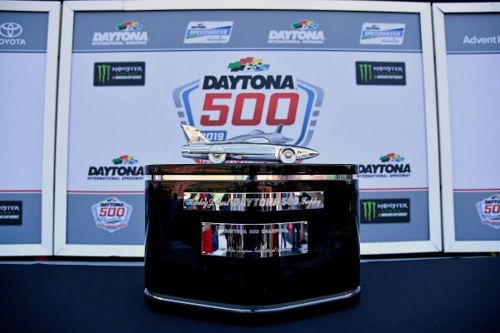
That trophy also marks the point where sponsor identity and trophy identity become inseparable. Borg-Warner is not a logo slapped onto a cup at the last minute. The company name is the trophy. The same is true at Daytona. The modern Harley J. Earl Trophy has, since 1998, featured Earl’s Firebird I concept car hand-sculpted by artist John Lajba perched on a black tri-oval base. That is rather more interesting than simply engraving a sponsor name on the front. It turns the prize into a little piece of automotive mythology: a race trophy with a jet-age concept car balanced on top of it like the world’s flashiest bonnet mascot.
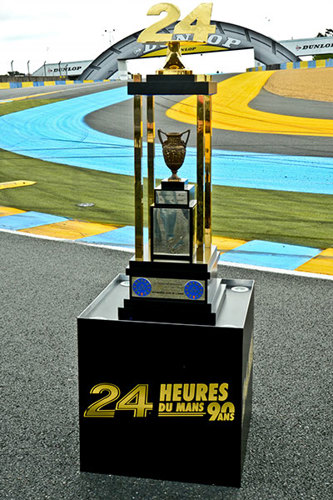
Endurance racing, meanwhile, has perfected the art of taking itself very seriously in a way that is also, if we are honest, wonderfully over the top. The 24 Hours of Le Mans Trophy weighs nearly 70kg, travels in an exquisite Louis Vuitton trunk, and is brought to the start line each year in a vintage car from the current holder’s collection during the official pre-race ceremony. That is not merely a trophy presentation. That is an entrance. It is the sort of thing that makes you suspect the trophy has a better travel arrangement than most of the spectators. Since 1993, the current Le Mans trophy has also had another deliciously dramatic wrinkle: if a manufacturer wins it three years in a row, they get to keep it in perpetuity. Audi, Porsche and Toyota have all managed it.
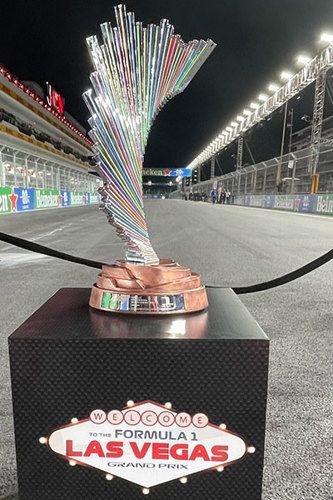
Formula 1 has become especially good at using trophies as part of the event’s visual identity. Sometimes that means old-school grandeur, as with Silverstone. Sometimes it means turning the host city into the object. Fox Silver’s Las Vegas Grand Prix trophy, for example, was designed with highly polished chrome, a matte copper base, and even a light-up function. Which is almost absurdly perfect for Las Vegas. A race in Vegas was never going to hand over a modest silver cup and call it quits. Of course the thing lights up.
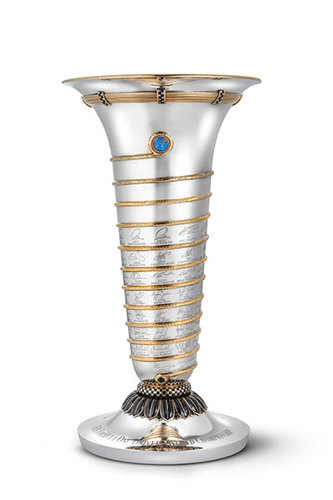
Fox Silver’s FIA Formula 1 World Championship Drivers’ Trophy has its own kind of theatrical ambition. Commissioned by Bernie Ecclestone in 1995, the brief was that it should last 100 years and include, retrospectively, the signatures of all world champions back to Giuseppe Farina in 1950. That is not really a winner’s cup so much as a portable hall of fame. It is F1 in object form: ceremonial, self-aware and entirely convinced of its own importance. Usually with good reason.
And then, just when you think trophies are all about tradition and gravitas, along comes Silverstone with a reminder that motorsport can still have a sense of humour. At the 2025 British Grand Prix, the podium trophies were not merely Lego-branded, but actually built from Lego bricks. The winner’s trophy was a gold-coloured brick-built take on the traditional RAC cup shape, while second and third place received similarly shaped versions in white with red and blue detailing. Lego says the winner’s trophy used 2,717 pieces, weighed more than 2kg, and was built by seven model-makers. Purists may have needed a quiet lie down, but it was also rather brilliant: a modern toy company recreating one of motorsport’s most traditional trophy silhouettes, brick by brick.
So what makes a great motorsport trophy? Not just size, though that helps. Not just silver content, though no one ever complained about a bit of sterling. It is the story. The Le Mans trophy arriving in a vintage car. The Borg-Warner growing a new face every year. The Tourist Trophy going full Greek mythology. Daytona sticking a concept car on top. Las Vegas making the thing glow. The best trophies are memorable because they tell you something about the event before you have even seen the race.
Because winning in motorsport is fleeting. The race ends, the overalls get damp with champagne, somebody puts on a sponsor’s cap that doesn’t suit them, and the moment races off into history. The trophy is the bit that lingers. The beautiful, over-designed, sometimes faintly ridiculous object that says: yes, this happened, and yes, it absolutely deserved some silver-plated theatre.


