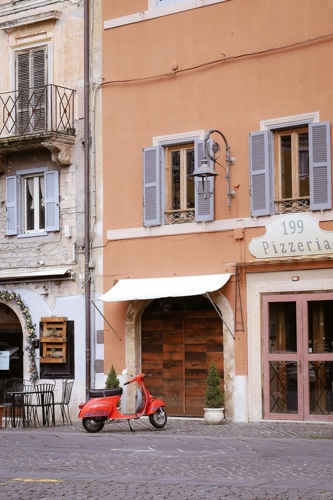


Some vehicles become famous because they are fast. Some because they are beautiful. Some because they won rallies, starred in posters or made small boys press their faces against dealership windows.
The Vespa became famous because it made ordinary transport look like a holiday.
On paper, the original Vespa was a small, practical scooter created for a post-war Italy that needed affordable mobility. Not glamour, cinema, or a thousand lifestyle photos involving sunglasses, espresso and suspiciously clean cobbled streets. Just a sensible way to get around.
And yet, 80 years after its arrival in 1946, the Vespa remains one of the most recognisable vehicles ever made. A scooter, yes, but also a design object, a cultural symbol and quite possibly the only two-wheeled machine that can make a trip to the shops feel faintly romantic.
The Vespa story begins with Piaggio, a company that had not originally set out to become a scooter legend. Before the Second World War, Piaggio was best known for aircraft, which explains why the first Vespa felt rather different from the oily, exposed, chain-driven motorcycles of the day. After the war, Italy needed rebuilding, factories needed new purpose, and people needed cheap, simple transport.
Enter Corradino D’Ascanio, an aeronautical engineer who was not especially fond of motorcycles. He thought they were dirty, awkward things. So instead of designing a traditional bike, he created something cleaner and more approachable: a step-through machine with enclosed bodywork, a leg shield, small wheels and no greasy chain waiting to ruin your trousers.
This is perhaps the most Vespa detail of all. It was not designed to be a motorcycle with smaller wheels. It was designed by someone who looked at motorcycles and thought, “No, thank you.”
The prototype was known as the MP6, and when Enrico Piaggio saw it, he is said to have remarked that it looked like a wasp – “vespa” in Italian. The name stuck, and frankly it could not have been better. The rounded rear, narrow waist and buzzing little engine all fitted the image perfectly. Much better than calling it the Piaggio Sensible Personal Mobility Device, which probably would not have caught on with the Mods.
The first Vespa 98 was presented in 1946, and early reactions were mixed. Some people were intrigued. Others were sceptical. Which is usually what happens when something genuinely new appears. But the idea was clever. The Vespa was easy to ride, relatively affordable, protective compared with a motorcycle and stylish in a way that felt completely unforced.
It helped, of course, that Italy knows a thing or two about making practical objects look good. The Vespa had a friendly face, neat proportions and a shape that seemed to smile at you.
Then came the cultural bit. The Vespa didn’t remain merely transport for long. By the 1950s, it had become part of the image of modern Italy: youthful, mobile, stylish and just the right amount of carefree. Its appearance in Roman Holiday in 1953, with Audrey Hepburn and Gregory Peck gliding through Rome, certainly did no harm. There are worse marketing strategies than having two Hollywood stars make your scooter look like the key to eternal sunshine.
In Britain, the Vespa took on a slightly different flavour. By the 1960s, it was part of Mod culture, lined up outside cafés and clubs, often wearing more mirrors and lights than seemed strictly necessary. If Italian Vespa culture was espresso and elegance, the British version added parkas, pop music and the faint possibility of a scuffle in Brighton. Still stylish, just with more attitude.
That adaptability is one of the reasons the Vespa has lasted. It can be chic, rebellious, practical, nostalgic or faintly ridiculous depending on who is riding it and how many accessories they have bolted to the front. It belongs equally to film posters, city streets, seaside rallies and garage collections.
And unlike many design icons, it never really had to reinvent itself beyond recognition. The details changed, engines grew, technology improved, and modern Vespas are far more refined than their 1940s ancestors. But the basic idea remains instantly familiar: step-through body, enclosed shape, compact wheels, cheerful purpose. You can show almost anyone a Vespa silhouette and they will know what it is.
Of course, it’s easy to get carried away. The original Vespa wasn’t magic. It was small, modestly powered and built to solve a practical problem. But that’s exactly what makes it so brilliant. It took the everyday business of getting from A to B and gave it charm.
Eighty years on, the Vespa still feels like proof that transport doesn’t have to be dull to be useful. It can be clever, approachable, stylish and just a little bit cheeky. Not bad for a wasp.