

In 2026, the British Grand Prix celebrates 100 years since its first running at Brooklands in 1926 – a century of speed, invention, national obsession and desperately unreliable weather.
But this is not just a story of circuits and winners. The British GP has always been defined by its cars: the fragile pre-war machines of Brooklands, the Alfa Romeos that launched the Formula 1 World Championship at Silverstone, the British-built innovators of the Lotus era, and the modern machinery that keeps Silverstone feeling like one of motorsport’s great stages.
1926: Delage 15 S 8 – the painful beginning
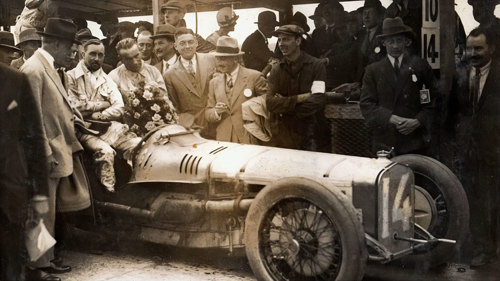
The first British Grand Prix was won by a Delage 15 S 8 after 110 laps of Brooklands, driven by Robert Sénéchal and Louis Wagner. Elegant, advanced and quick, the Delage should have been remembered simply as the car that started the British GP story.
Instead, there is one detail that rather steals the show: its exhaust system had a habit of burning the drivers’ feet. Which does take some of the glamour out of pre-war Grand Prix racing. All very heroic until your footwear begins to suffer.
That detail cuts through the sepia tint. These weren’t delicate museum pieces at the time. They were brutal working machines, driven by people expected to endure noise, heat, vibration and fatigue with the minimum of complaint. Modern drivers talk about tyre degradation. Their predecessors were being gently roasted by the car.
1950: Alfa Romeo 158 – Silverstone joins the big league
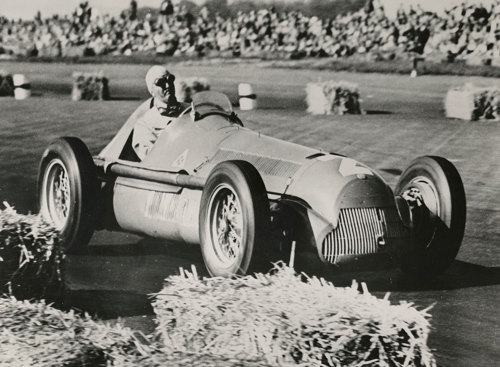
Silverstone’s great trick was turning a wartime airfield into one of motor racing’s spiritual homes. The 1950 British Grand Prix was the first race of the new Formula 1 World Championship, and Alfa Romeo arrived with the 158, nicknamed the Alfetta, looking like it had unfinished business.
It did. Giuseppe “Nino” Farina won, with Alfa Romeos filling the podium, and the British GP suddenly became more than a national event. It was there at the birth of modern Formula 1.
The 158 itself had roots before the war, which makes its dominance even more impressive. Or slightly embarrassing for everyone else, depending on how generous you’re feeling. Either way, Silverstone had arrived.
1967: Lotus 49 – Britain stops just hosting and starts inventing
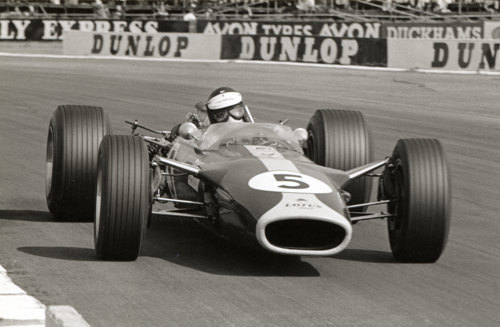
By the 1960s, Britain was no longer merely providing the circuit. It was building the cars that defined the sport.
The Lotus 49 is the perfect example. Colin Chapman, never knowingly fond of unnecessary weight, paired the car with the new Cosworth DFV engine and used that engine as a structural part of the chassis. It was clever, efficient and faintly ruthless – all the ingredients of a proper British engineering breakthrough.
Jim Clark won on the car’s debut in 1967, because apparently introducing one of the most important F1 designs of the era wasn’t dramatic enough on its own.
The Lotus 49 marks the moment Britain’s racing industry found its voice. The great F1 powers were no longer just grand continental marques. They were teams working from British workshops, where genius and improvisation often appeared to share the same kettle.
1970s: Lotus 72 – when the future got wedge-shaped
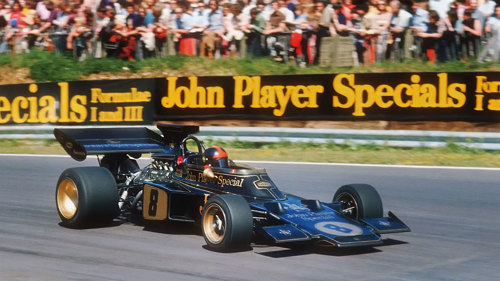
If the Lotus 49 helped rewrite the engineering, the Lotus 72 rewrote the silhouette. Gone was the older cigar-shaped look. In came a wedge profile, side-mounted radiators and a lower, sharper nose. It looked like Formula 1 had suddenly discovered the future and decided it should have better cheekbones.
The 72 was also unusually long-lived for a Grand Prix car, competing across several seasons and winning world championships with Jochen Rindt and Emerson Fittipaldi. In a sport where yesterday’s innovation can become tomorrow’s museum piece alarmingly quickly, that staying power says plenty.
It was beautiful, influential and dangerous in that very 1970s way, where everything seemed to be advancing quickly and safety was still trying to catch the train.
1992: Williams FW14B – Mansell, Red 5 and national hysteria
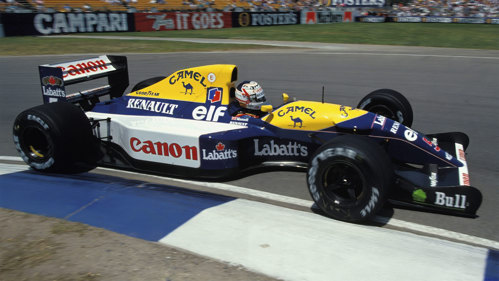
Some cars are remembered for engineering. Some for emotion. The Williams FW14B managed both. Technically, it was extraordinary: active suspension, semi-automatic gearbox, Renault V10 power and enough electronic cleverness to make rivals look as if they had brought a pencil case to a space programme. Emotionally, it was Nigel Mansell’s Red 5 at Silverstone in 1992, which means it comes with a soundtrack of crowd noise before you’ve even seen a photograph.
Mansell won the British Grand Prix that year and the crowd poured onto the circuit afterwards, surrounding the car in scenes that now look wonderfully chaotic. Try imagining that happening in quite the same way today. Somewhere, a health and safety officer just woke up in a cold sweat.
The FW14B is an icon in its own right: rare, technically fascinating, deeply collectible and tied to a moment that still feels unmistakably British.
Silverstone today: the living archive
The modern British Grand Prix is a different world. The cars are wider, heavier, vastly more complex and managed by streams of data that would make a 1920s riding mechanic throw his spanner into a hedge.
And yet Silverstone still works because it carries the whole story with it. The old airfield has become a modern stage, but the atmosphere remains unusually human: grandstands full of flags, weather that refuses to behave, and a crowd that treats the race as part sporting event, part annual pilgrimage.
Lewis Hamilton’s Silverstone years have added another layer, of course, but the bigger point is that the British GP never became a museum piece. It is still alive, still loud, still capable of producing moments that people talk about years later. A century after Brooklands, that feels about right.
From burnt feet to hybrid power
But then the British Grand Prix has always been more than a date on the calendar. It is a rolling timeline of racing machinery, from the foot-roasting Delage to Silverstone’s modern hybrid era.
Not always sensible. Not always comfortable. But never ordinary.


