

Imagine going to a motor show and finding that the most exciting thing on the stand isn’t a finished car. No paint. No leather. No impossibly glamorous bodywork. Just a chassis, some wheels and a V12 engine sitting behind where the driver would go, looking as if someone had accidentally wheeled a racing prototype into a room full of polite grand tourers.
That’s roughly what happened at the Turin Motor Show in 1965, when Lamborghini showed the bare bones of what would become the Miura. It wasn’t even wearing the famous body yet, but the message was already clear: something strange and rather serious was happening in Sant’Agata.
By the time the finished Miura appeared at Geneva in 1966, the strange thing had become one of the most beautiful road cars ever made. And in 2026, 60 years later, it’s still the car people point to when they talk about the birth of the modern supercar.
That phrase gets thrown around a lot, usually by people standing near something orange and very expensive. But with the Miura, it fits. Here was a low, wide, mid-engined V12 Lamborghini at a time when most front-rank performance cars still put their engines up front like respectable adults. The Miura didn’t look respectable. It looked like it had escaped.
The best bit is that it wasn’t originally some carefully planned boardroom masterstroke. Lamborghini’s young engineers – Gian Paolo Dallara, Paolo Stanzani and Bob Wallace – were fascinated by the idea of a road car with racing-style engineering. Ferruccio Lamborghini, famously, wasn’t especially interested in racing. He wanted fast, refined road cars, not a Ferrari-style competition circus with oily mechanics and expensive arguments.
So the Miura began with a whiff of after-hours enthusiasm. The engineers worked on the concept, convinced it could be something remarkable. When Ferruccio saw the potential, he allowed it to go ahead, partly because even if it didn’t sell in huge numbers, it would be a useful way of getting people to talk about Lamborghini.
Well, that worked.
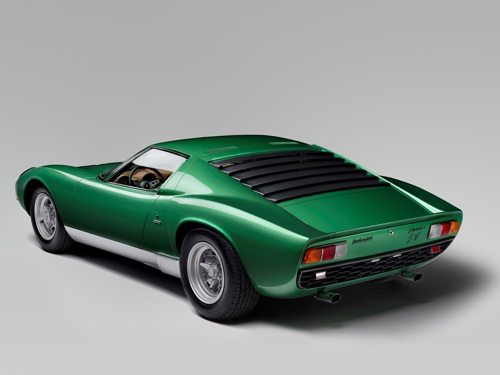
Bertone took on the body design, and the young Marcello Gandini created a shape that still looks faintly outrageous today. The Miura is often called beautiful, which is true, but it’s more interesting than that. It’s pretty and predatory at the same time. The nose sits low, the cabin is pushed forward, the rear haunches swell around the engine, and those famous headlamp “eyelashes” give it a look that’s half glamour model, half startled insect.
The name helped too. Miura came from a famous Spanish fighting bull breeder, which set the tone for Lamborghini’s bull-themed naming tradition. It also suited the car rather neatly: dramatic, muscular, slightly theatrical and probably best treated with respect.
Underneath, the Miura was just as bold as it looked. Its 4.0-litre V12 was mounted transversely behind the seats, a layout that helped keep the car compact but also gave it the sort of mechanical drama that makes engineers start using hand gestures. Early cars could be lively, and not always in the reassuring sense. High-speed front-end lift was one of the Miura’s less charming habits, and the original P400 shared its engine and gearbox oil, which is the sort of thing that sounds clever until you think about all the expensive metal involved.
But that’s part of the Miura’s character. It wasn’t a sanitised modern supercar with endless electronic safety nets and a screen asking which mood you’re in. It was a young company pushing hard, learning fast and building something that looked as though it belonged five, ten, even 15 years in the future.
Celebrities noticed, obviously. The Miura had exactly the right combination of beauty, danger and inconvenience to appeal to the sort of people who wore sunglasses indoors. Rod Stewart had one. Miles Davis had one too, though his relationship with it ended painfully after a crash in New York. It also made one of cinema’s great automotive appearances in the opening sequence of The Italian Job, gliding through Alpine roads before meeting a rather unfortunate end. If a car can become legendary while being destroyed before the plot has properly started, it’s doing something right.
Lamborghini kept improving the Miura through the P400, P400 S and SV versions, taming some of the early quirks and adding more polish. Yet the original idea remained the same: a spectacular engine, radical packaging and styling that made almost everything else look a bit timid.
Only 763 Miuras were built between 1966 and 1973, which feels absurd now. Then again, perhaps that’s part of the magic. It wasn’t common, practical or sensible. It didn’t try to be all things to all people. It was a statement – and a very loud one.
Sixty years on, the Miura still matters because it didn’t just move the goalposts. It made everyone realise there were goalposts in a different field entirely.
The supercar was coming anyway, sooner or later. The Miura just got there first, looked fabulous doing it, and left the rest of the world to catch up.


