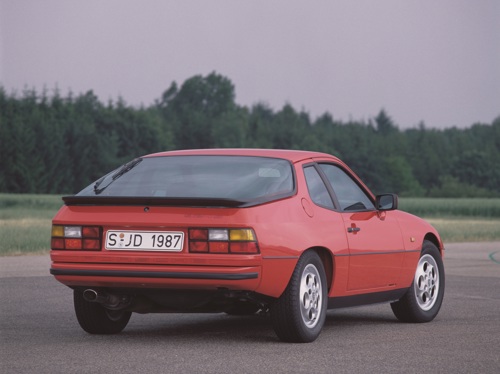

There’s a certain type of Porsche enthusiast who likes things just so. Engine in the back. Air cooling. Six cylinders. A shape that can be traced back, spiritually if not literally, to the 1960s. Mention the Porsche 924 to that person and you may get a pause. Possibly a raised eyebrow. In extreme cases, a small noise of disappointment. Which is a shame, because the 924 has always been more interesting than the sniffy comments suggest.
Launched in 1976, and celebrating its 50th anniversary in 2026, the 924 was Porsche doing something properly unfamiliar. Front engine. Water cooling. Four cylinders. A large glass hatch. Practical 2+2 layout. It was the sort of thing that made traditionalists wonder whether Stuttgart had been left unsupervised.
The best part? It wasn’t originally meant to be a Porsche at all.
The car began life as a joint Volkswagen-Porsche project, known as EA425. Volkswagen wanted a new sporting coupe, and Porsche was commissioned to develop it. Then things changed. VW decided it didn’t want the car after all, partly because its own Scirocco was already taking shape as a cheaper, Golf-based coupe. Porsche, seeing rather a lot of work about to go to waste, bought the project back.
So the 924 arrived with one of the strangest origin stories in the Porsche family album: developed for Volkswagen, built at Audi’s Neckarsulm plant, powered by a Volkswagen/Audi-derived engine, and sold with a Porsche badge on the nose.
No wonder the purists got twitchy.
But here’s the thing. The 924 may not have followed the traditional Porsche recipe, but it was still engineered with proper Porsche thinking. The engine sat at the front, while the gearbox was placed at the rear in a transaxle layout. That helped give the car near-even weight distribution, which is a very neat way of saying it didn’t just look balanced – it actually was. And balance matters. Especially when your sports car isn’t relying on enormous power to do all the talking.
The early 924 wasn’t outrageously quick. In fact, compared with the mythology around the Porsche badge, it could seem almost modest. The 2.0-litre four-cylinder engine had its roots in the wider Volkswagen and Audi world, which led to the usual pub jokes about van engines. As ever, the truth was more nuanced, but “actually, it’s a bit more complicated than that” rarely travels as well as a cheap gag.
Still, the 924 was never really about brute force. It was about being usable, efficient, modern and tidy through corners. It had clean lines, pop-up headlights, a big tailgate and enough luggage space to make weekend trips feel realistic rather than optimistic. In that sense, it was closer to a clever everyday sports coupe than a junior supercar.
By the mid-1970s, Porsche couldn’t simply live on the 911 forever, even if plenty of people now like to pretend that was obvious and inevitable. The company needed broader appeal, better efficiency and cars that made sense in a world dealing with fuel crises, changing regulations and buyers who wanted performance without too much pain. The 924 helped give Porsche a new entry point and brought customers into the brand who might never have considered a 911.
It also laid the foundations for Porsche’s transaxle era. The 924 led towards the 944, the 968 and, in parallel spirit, the 928. For a while, this front-engined family wasn’t a weird footnote. It was a major part of Porsche’s future.
The 924 got more interesting as time went on too. The 924 Turbo gave it a useful dose of extra performance, while the Carrera GT turned the polite coupe into something far more serious. With swollen arches, bonnet scoop and motorsport intent, the Carrera GT looked like the standard car had stopped answering emails and taken up rallying.
That’s one of the joys of the 924 story. It starts as the Porsche people weren’t sure they wanted, then gradually becomes impossible to ignore. It sold in strong numbers, helped the company financially, introduced new buyers to the brand and proved that Porsche could do more than refine the 911-shaped idea indefinitely.
Was it perfect? Of course not. Some early interiors were a bit parts-bin, some people wanted more power, and the image problem followed it around for years like a small, irritating dog. But time has been kind to the 924. Today, its honesty is part of the appeal. It’s light, usable, distinctive and far less obvious than many classics wearing more fashionable badges.
Fifty years on, the Porsche 924 deserves its moment. Not because it was the purest Porsche, or the fastest, or the one that made bedroom walls tremble.
Because it was the outsider that earned its place. Sometimes, that’s the better story.